 AvioADSB
How Does ADS-B Work? From Aircraft to Your Receiver
How does ADS-B work? Learn how aircraft broadcast position on 1090 MHz and how a cheap RTL-SDR receiver at home can pick it up and share it with a network.
How does ADS-B work? An aircraft works out its own position by satellite navigation and its transponder broadcasts that position, plus its identity, altitude and speed, on 1090 MHz. Nobody has to ask for it. Any receiver in range can listen, including a small USB dongle on your desk.
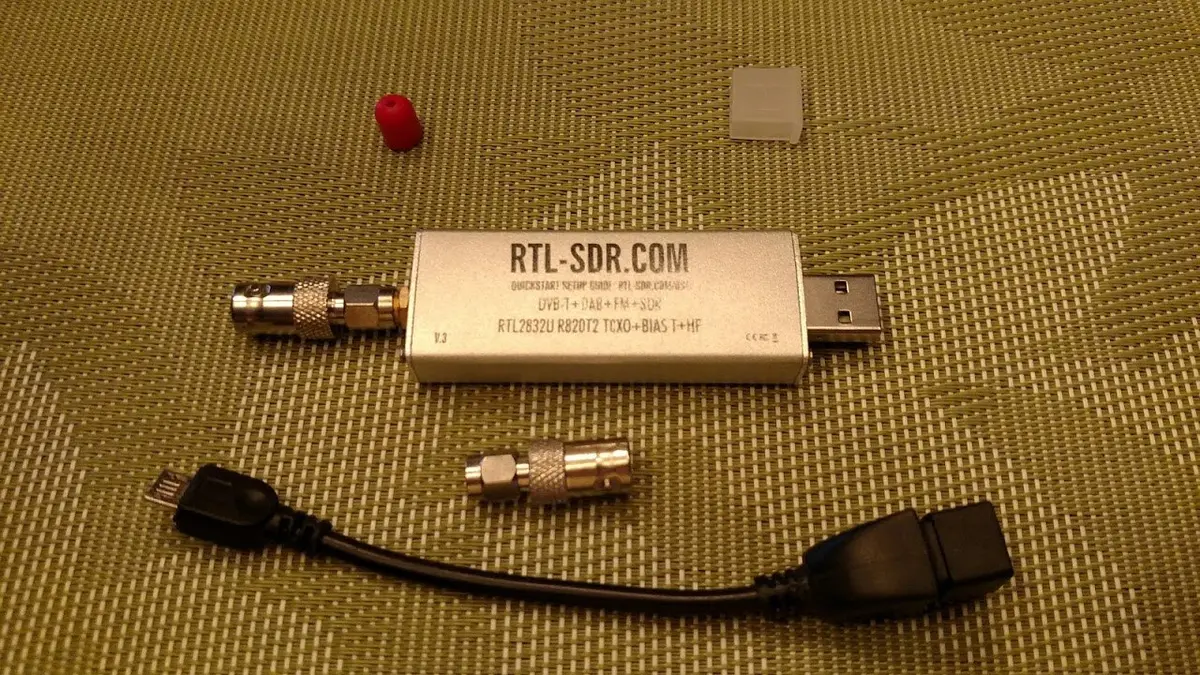
An RTL-SDR dongle. Photo: Joeceads, CC BY-SA 4.0, via Wikimedia Commons.
What an aircraft actually sends
ADS-B stands for Automatic Dependent Surveillance-Broadcast. The RTL-SDR project describes it as a Mode S transponder that periodically broadcasts location and altitude, and notes that the signal is on 1090 MHz.
Each transmission is a short digital message. According to the mode-s.org ADS-B guide, a frame is 112 bits long and contains:
- the aircraft's 24-bit ICAO address (the "hex code", a unique identifier that generally stays with the aircraft)
- a message body, which can carry the callsign, airborne or surface position, or velocity
The same guide lists how often some messages go out: airborne position and velocity at 2 Hz, so roughly twice per second, and identification every 5 to 10 seconds. That is why a plane on your map moves smoothly.
How the signal reaches a receiver
ADS-B is a one-way broadcast. A receiver does not talk to the aircraft, it just listens. The signal travels in a straight line, so the RTL-SDR guide advises mounting the antenna as high as possible and clear of trees and buildings. Planes near the horizon are the usual targets, which is why a good 1090 MHz antenna and careful placement matter more than expensive electronics.
From radio waves to a dot on the map
A home receiver has three parts working in a chain:
- Antenna: a vertically polarized 1090 MHz antenna picks up the radio signal.
- SDR dongle: an RTL-SDR dongle turns the radio signal into data a computer can process.
- Decoder software: a program such as readsb decodes the 112-bit frames into aircraft positions, and a viewer such as tar1090 draws them on a map.
A Raspberry Pi is enough to run all of it. See what a complete receiver costs before you buy anything.
Why a network of receivers helps
One receiver covers the area it can see. Many receivers, put together, cover far more, including places where aircraft are missed on flight trackers. Some aircraft also send messages without a position, and a network can still locate them using MLAT.
That is what AvioADSB is: volunteers who run receivers and share what they pick up. If you already feed another network, you can send the same data to AvioADSB too.
Build the receiver that listens
Now you know what is being broadcast over your head. Start with the AvioADSB hardware list, and when your receiver is running, connect it in a few minutes.