 AvioADSB
1090 MHz Antenna for ADS-B: What to Buy
Choosing a 1090 MHz antenna for ADS-B? Compare the stock dongle antenna, a tuned DIY build and a dedicated collinear, then connect your receiver to AvioADSB.
The right 1090 MHz antenna for ADS-B is a vertically polarized one tuned to 1090 MHz, ideally a dedicated ADS-B antenna (about $20-40) mounted outdoors. If you only want to try things out, the antenna that came with your dongle works for short range, and a tuned DIY build costs a few dollars. Here is how to pick.
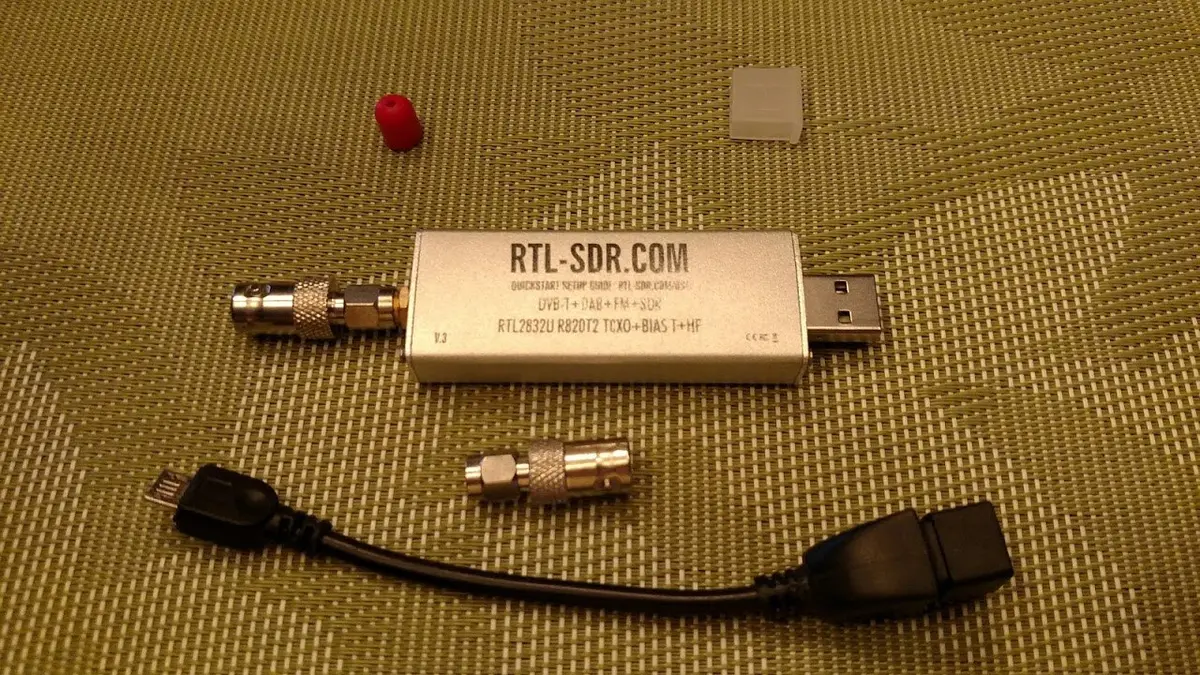
An RTL-SDR dongle. Photo: Joeceads, CC BY-SA 4.0, via Wikimedia Commons.
What a 1090 MHz antenna needs to do
Aircraft send ADS-B on 1090 MHz from a vertical antenna, so FlightAware's PiAware documentation says to use a vertical antenna of your own. The rtl-sdr.com ADS-B tutorial puts it the same way: ADS-B uses a vertically polarized signal, so only certain types of antennas work. A poorly tuned one gives you less range.
Your three options
1. The stock antenna from your dongle kit
The same tutorial says the stock antenna may already pick up ADS-B, depending on distance and local interference, but a properly tuned antenna is needed for decent range. It also warns that the thin coax on a stock antenna can cost several dB of signal. Good for a first test, not for the long term.
2. A tuned DIY antenna
A quarter-wave ground plane or a simple dipole tuned to 1090 MHz is the cheapest real upgrade. Our DIY 1090 MHz antenna guide walks through a ground plane build.
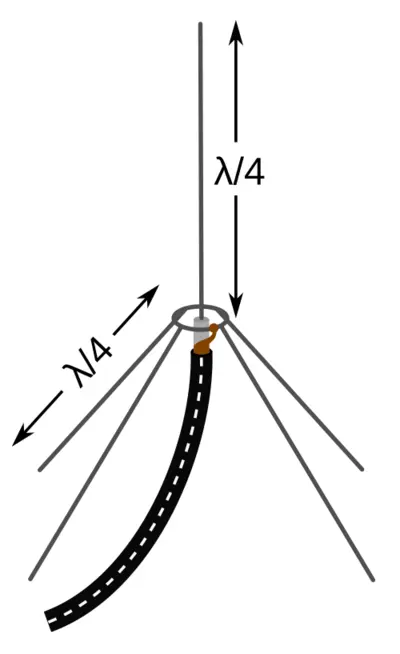
Ground plane antenna. Diagram: Chetvorno, CC0, via Wikimedia Commons.
3. A dedicated ADS-B antenna
Our hardware guide puts a dedicated ADS-B antenna at about $20-40, and it is the easiest route to better range: pre-tuned, weatherproof and built for outdoor use. Many of these are collinear designs. According to rtl-sdr.com, a collinear has very high omnidirectional gain directed towards the horizon, and a coax collinear with 4-6 elements is probably enough, because too many elements make the pattern too flat.
Check connectors and cable before you buy
- Connector: FlightAware notes that most external antennas have an N-type female connector, while the Pro Stick and Pro Stick Plus have an SMA female connector. Check what your dongle uses and buy the right cable or adapter.
- Cable loss: FlightAware says total cable attenuation should be below 6 dB, with runs under about 15 m (50 ft) when possible. Use at least LMR-240 or equivalent under 15 m, and at least LMR-400 or equivalent beyond that.
- Skip flat coax: it is not recommended, because it uses F-type connectors and is not optimized for 1090 MHz.
- Waterproof outdoor joints with self-amalgamating tape.
Placement beats price
Even the best antenna loses to a bad location. Mount it vertically, high up, with a clear view of the sky, as covered in the antenna placement guide. If you see few aircraft, check the low message rate checklist before buying anything new.
From antenna to feeding
Once the antenna is up, your receiver can share what it hears. AvioADSB is a community network, and you can feed it alongside any network you already feed. For the full parts list, see the cost breakdown.
Ready to start?
No receiver yet? Start with the hardware list. Already have one running? Connect your receiver to AvioADSB in a few minutes.