 AvioADSB
What Is ADS-B Out and ADS-B In? A Plain Guide
What is ADS-B Out and ADS-B In? Learn which one your home receiver listens to, how 1090 and 978 MHz fit in, and how to start feeding aircraft data.
ADS-B Out is what an aircraft transmits. ADS-B In is what an aircraft receives. A home receiver like the ones in the AvioADSB network is not an aircraft, so it never uses ADS-B In: it simply listens to the ADS-B Out broadcasts that planes send all the time.
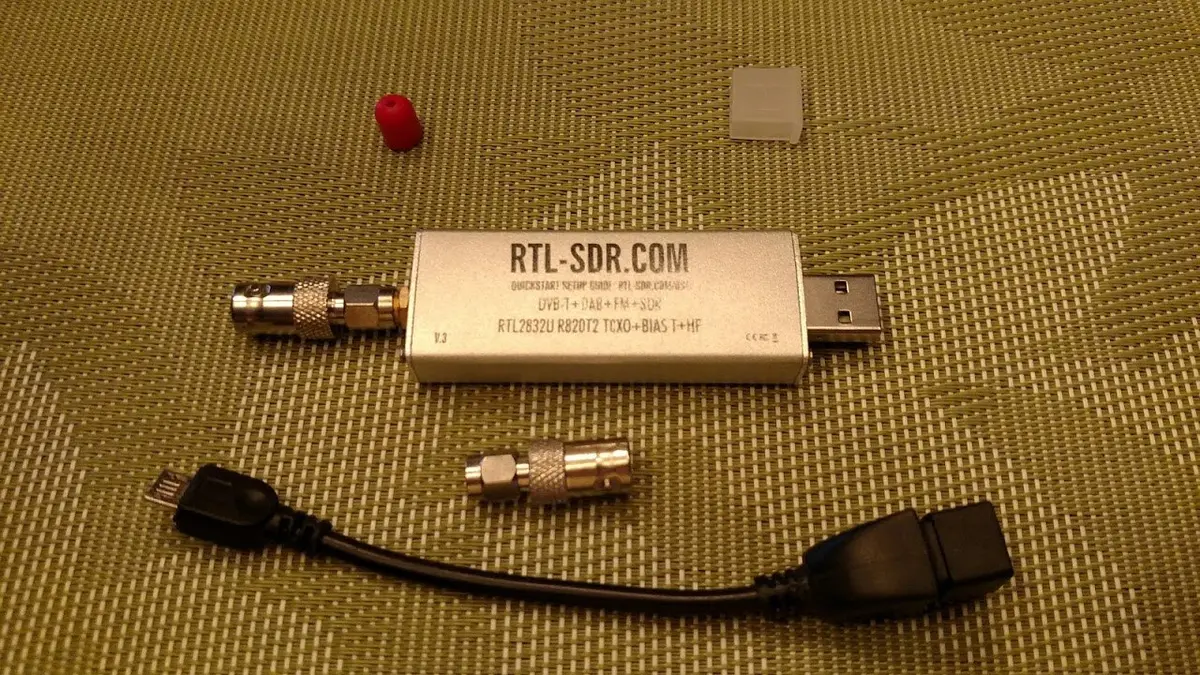
An RTL-SDR dongle. Photo: Joeceads, CC BY-SA 4.0, via Wikimedia Commons.
ADS-B Out: the broadcast you can receive
ADS-B Out is the transmission of an aircraft's identity, position and other data. As the RTL-SDR project notes, ADS-B broadcasts at 1090 MHz, and a cheap RTL-SDR dongle can listen to it. That is the signal behind every dot on a flight tracker. For the details of what is inside each message, read how ADS-B works.
ADS-B In: the cockpit side
ADS-B In is the receiving side on board an aircraft. AOPA explains that the US mandate that took effect on January 1, 2020 applies only to ADS-B Out, so ADS-B In is optional. Pilots who add it can see nearby traffic and, on 978 MHz, weather in the cockpit.
1090 MHz and 978 MHz
According to the same AOPA article, 1090 MHz is used worldwide for traffic, while 978 MHz (UAT) is a second, US-only link that carries traffic and weather (FIS-B). Ground stations rebroadcast traffic on both frequencies, which is how a pilot on one link sees aircraft using the other.
For a ground receiver this matters in one way: most aircraft you will see are on 1090 MHz, so that is where a first receiver should listen. If you live in the US and want to try the second link, see our guide to a 978 MHz UAT receiver.
Which one does your receiver use?
Neither, strictly. Your receiver is ground based and passive:
- It never transmits, so it does not use ADS-B Out.
- It does not need ADS-B In, because that is a cockpit feature.
- It decodes the ADS-B Out signals of planes in range, using an antenna, an RTL-SDR dongle and software such as readsb.
Why this leads to feeding
Every aircraft with ADS-B Out is already broadcasting to anyone who listens. A single receiver only hears the planes within its line of sight, so the more volunteers listen, the fewer gaps there are. If you want to know what a complete receiver costs, the answer is usually a Raspberry Pi, a dongle and an antenna.
Already running a receiver for another network? You can feed AvioADSB from the same receiver with one extra connector line.
Build a receiver that listens
Ready to hear ADS-B Out for yourself? Start with this hardware list, and when your receiver is running, connect it to AvioADSB in a few minutes.