 AvioADSB
Is Feeding ADS-B Data Safe? What You Actually Share
Is feeding ADS-B data safe? See what a receiver shares, how AvioADSB treats your location and IP address, and how to stop feeding at any time.
Is feeding ADS-B data safe? For most people, yes: a feeder forwards aircraft signals that are already broadcast in the open, not a copy of your files or browsing. This page explains exactly what leaves your receiver on AvioADSB, what is stored, and how to switch it off.
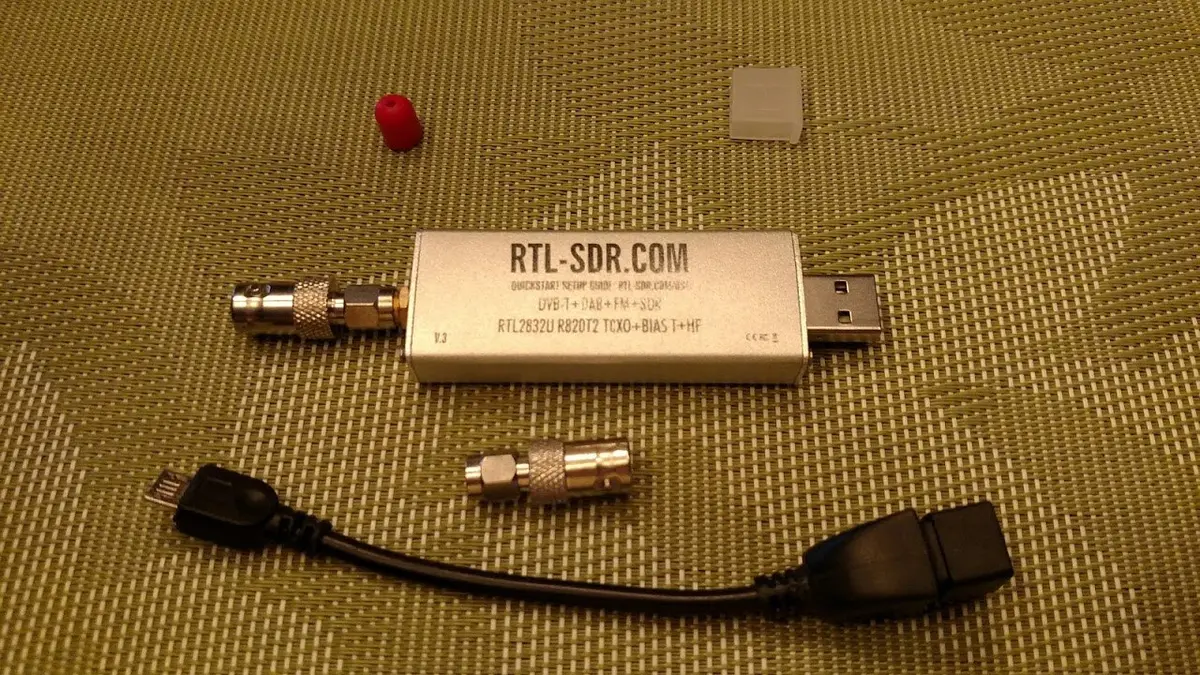
An RTL-SDR dongle. Photo: Joeceads, CC BY-SA 4.0, via Wikimedia Commons.
What a feeder actually shares
Aircraft transponders broadcast their location and altitude on 1090 MHz, and the RTL-SDR project notes that a cheap RTL-SDR dongle can listen to these signals. Anyone with a receiver and a clear view of the sky can pick them up.
According to the AvioADSB data policy, a feeder sends:
- Decoded ADS-B and Mode S messages: aircraft address, callsign, position, altitude, speed and squawk.
- A station identifier (a UUID or feed token).
- The public IP address the feed connects from.
- Your precise location and antenna height, only if you choose to enter them.
How AvioADSB treats your location
You do not have to enter a location. The policy says that without one, a rough position is estimated from your IP address and shown rounded. If you do enter coordinates, they are used only on the server, to check that reported positions are physically receivable from where you are. No API, page or export returns them, and public maps round receiver positions to a grid of about 28 km.
What is stored, and for how long
- Aircraft data is held in memory for about a minute and is not archived.
- Each station keeps daily totals: messages, distinct aircraft and maximum range per compass sector.
- IP addresses are cleared once a station has not connected for 90 days.
- An account (email, username, password hash) is only needed if you want an API key.
The policy also says station locations, feeder identities and IP addresses are never sold or licensed. Read the full data policy before you join, so you can decide for yourself.
Keep your feed token private
Treat the feed token or station UUID like a password. Anyone who holds it can feed data as your station, or claim it. Do not post it in forums or screenshots, and rotate the token from the dashboard if it leaks.
How to stop feeding
Remove the connector line from your decoder configuration, or stop the feeder script. The station goes offline and nothing else is needed. Deleting a claimed station or your account from the dashboard removes its location and statistics.
Feeding more than one network
A receiver only decodes what the antenna hears, so it can serve several networks at once. Each network has its own policy, so read each one. Our guide to feeding multiple networks from one receiver shows how the pieces fit.
Decided it is worth a try?
If you want to see how the hobby works first, what an ADS-B receiver costs breaks down the parts. Then start with the AvioADSB hardware list, or if your receiver already runs, connect it in a few minutes.